Dynomotion

Group: DynoMotion Message: 12918 From: Colin Fera Date: 3/8/2016
Subject: grounding (computer, drives, kflop)
I am having a strange problem,  I thought at first that it was an issue with voltage levels between KFLOP and the drives (step/direction signals) but it seems to be a grounding problem.

Background:
I am using brushless servos where the drives are connected to mains. The drives have separate inputs for the servo power supply and for the drives logic power supply.  The drive logic is connected to a power line filter as recommended in the drives instruction manual.  The drives metallic mounting plate is at earth ground and there is a star earth ground connecting the drives to the breaker panels earth ground. This is also the earth ground for the casting of the machine.


How the problem presents itself:  I command a movement that amounts to 1000 steps. It misses steps and moves maybe 950 steps.  I know this from the drives encoder output which is connected to the kanalog encoder input.

The drives have a serial interface that's used for configuring them. Its a TTL level serial interface and the drives came with a level shifter dongle that I have connected to a USB to serial converter. If this is plugged in the drives work perfectly.  The computer gets earth ground from being plugged into the mains. It shares this with the kflop through USB.  So the KFLOPS 0v is actually earth ground. It also provides earth ground to the drives via the USB to serial interface.

If I connect the USB to serial interface to the drives, then they work perfect and don't miss any steps.  The USB to serial interface is putting earth ground which is also kflops signal ground into the drives.

I tried isolating the computer using an isolated power supply that didn't give the computer earth ground and this made things worst.

So should I tie the drives signal ground to the kflop ground? 

-Colin

Group: DynoMotion Message: 12921 From: Tom Kerekes Date: 3/8/2016
Subject: Re: grounding (computer, drives, kflop)
Hi Colin,

Its hard for me to follow without a diagram.  Any shields involved?

But it seems the PC/KFLOP are ultimately earth grounded to one earth ground but the drives are earth grounded to a different earth ground.  This could result in big fluctuations between the KFLOP Gnds and the Drive Gnds.  I wouldn't normally expect that to be an issue as the signals are optically isolated.  But somehow it seems signal currents are being induced.  Connecting a wire (the serial cable) between the devices would tend to reduce the relative fluctuations (but add a ground loops).  Maybe move the Computer Earth Gnd connection to your "star" point that the drives use?

You might temporarily remove the earth ground connections and verify that grounds in the drive and KFLOP are in fact isolated and the connections to earth ground will be where you expect.  Sometimes there are unexpected ground connections through shields, enable signals, the frame, etc....

HTH
Regards
TK

On 3/8/2016 8:31 AM, Colin Fera colin.fera@... [DynoMotion] wrote:
 
I am having a strange problem,  I thought at first that it was an issue with voltage levels between KFLOP and the drives (step/direction signals) but it seems to be a grounding problem.

Background:
I am using brushless servos where the drives are connected to mains. The drives have separate inputs for the servo power supply and for the drives logic power supply.  The drive logic is connected to a power line filter as recommended in the drives instruction manual.  The drives metallic mounting plate is at earth ground and there is a star earth ground connecting the drives to the breaker panels earth ground. This is also the earth ground for the casting of the machine.


How the problem presents itself:  I command a movement that amounts to 1000 steps. It misses steps and moves maybe 950 steps.  I know this from the drives encoder output which is connected to the kanalog encoder input.

The drives have a serial interface that's used for configuring them. Its a TTL level serial interface and the drives came with a level shifter dongle that I have connected to a USB to serial converter. If this is plugged in the drives work perfectly.  The computer gets earth ground from being plugged into the mains. It shares this with the kflop through USB.  So the KFLOPS 0v is actually earth ground. It also provides earth ground to the drives via the USB to serial interface.

If I connect the USB to serial interface to the drives, then they work perfect and don't miss any steps.  The USB to serial interface is putting earth ground which is also kflops signal ground into the drives.

I tried isolating the computer using an isolated power supply that didn't give the computer earth ground and this made things worst.

So should I tie the drives signal ground to the kflop ground? 

-Colin

Group: DynoMotion Message: 12926 From: Colin Fera Date: 3/8/2016
Subject: Re: grounding (computer, drives, kflop)
Hi Tom,

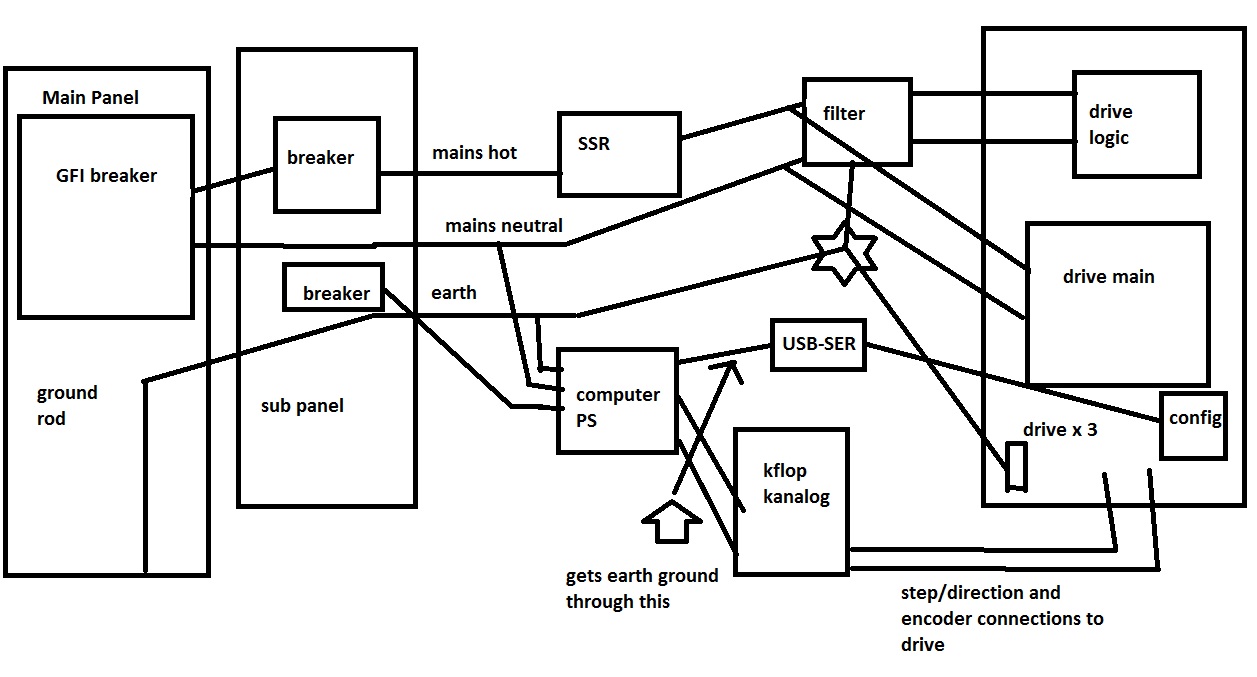
I made a crappy diagram. I think it might hurt more than it helps but its attached here.

All the signal wires going between the drives and kflop are shielded and the shields are earthed through the drive.  I did it this way because the drive has DB9 and DB25 connectors for its signal wires and the shell is connected to earth in the drive so it was the easiest way.

Connecting the PC to the star ground is a good idea. Should the PC connect to power via a noise filter?

This is the filter the drive manufacturer recommended for the their logic power supply input: http://www.mouser.com/ds/2/355/FN610-189083.pdf

Thanks,
-Colin

On Tue, Mar 8, 2016 at 11:38 AM, Tom Kerekes tk@... [DynoMotion] <DynoMotion@yahoogroups.com> wrote:
 

Hi Colin,

Its hard for me to follow without a diagram.  Any shields involved?

But it seems the PC/KFLOP are ultimately earth grounded to one earth ground but the drives are earth grounded to a different earth ground.  This could result in big fluctuations between the KFLOP Gnds and the Drive Gnds.  I wouldn't normally expect that to be an issue as the signals are optically isolated.  But somehow it seems signal currents are being induced.  Connecting a wire (the serial cable) between the devices would tend to reduce the relative fluctuations (but add a ground loops).  Maybe move the Computer Earth Gnd connection to your "star" point that the drives use?

You might temporarily remove the earth ground connections and verify that grounds in the drive and KFLOP are in fact isolated and the connections to earth ground will be where you expect.  Sometimes there are unexpected ground connections through shields, enable signals, the frame, etc....

HTH
Regards
TK


On 3/8/2016 8:31 AM, Colin Fera colin.fera@... [DynoMotion] wrote:
 
I am having a strange problem,  I thought at first that it was an issue with voltage levels between KFLOP and the drives (step/direction signals) but it seems to be a grounding problem.

Background:
I am using brushless servos where the drives are connected to mains. The drives have separate inputs for the servo power supply and for the drives logic power supply.  The drive logic is connected to a power line filter as recommended in the drives instruction manual.  The drives metallic mounting plate is at earth ground and there is a star earth ground connecting the drives to the breaker panels earth ground. This is also the earth ground for the casting of the machine.


How the problem presents itself:  I command a movement that amounts to 1000 steps. It misses steps and moves maybe 950 steps.  I know this from the drives encoder output which is connected to the kanalog encoder input.

The drives have a serial interface that's used for configuring them. Its a TTL level serial interface and the drives came with a level shifter dongle that I have connected to a USB to serial converter. If this is plugged in the drives work perfectly.  The computer gets earth ground from being plugged into the mains. It shares this with the kflop through USB.  So the KFLOPS 0v is actually earth ground. It also provides earth ground to the drives via the USB to serial interface.

If I connect the USB to serial interface to the drives, then they work perfect and don't miss any steps.  The USB to serial interface is putting earth ground which is also kflops signal ground into the drives.

I tried isolating the computer using an isolated power supply that didn't give the computer earth ground and this made things worst.

So should I tie the drives signal ground to the kflop ground? 

-Colin


  @@attachment@@
Group: DynoMotion Message: 12927 From: Tom Kerekes Date: 3/8/2016
Subject: Re: grounding (computer, drives, kflop) [1 Attachment]
Hi Colin,

It might be better to ground the Step/Dir shields on the KFLOP end to KFLOP DC GND and not at the Drive end.  With the shield connected to the potentially noisy Drive Case/Earth Gnd you could be coupling all that noise directly into the cable shield and in turn the Step/Dir signals.

I also wonder about the encoder signals.  Where do they get power and is that isolated from the drive Gnds?  I also wonder if the problem is with the Step/Dir signals or the encoder signals?  The encoder would read the wrong position in both scenarios.  If there is some way you can check how far the axis physically moves (or returns back to the starting point) that should allow you to determine which has the error.

Regards
TK

On 3/8/2016 2:21 PM, Colin Fera colin.fera@... [DynoMotion] wrote:
 
Hi Tom,

I made a crappy diagram. I think it might hurt more than it helps but its attached here.

All the signal wires going between the drives and kflop are shielded and the shields are earthed through the drive.  I did it this way because the drive has DB9 and DB25 connectors for its signal wires and the shell is connected to earth in the drive so it was the easiest way.

Connecting the PC to the star ground is a good idea. Should the PC connect to power via a noise filter?

This is the filter the drive manufacturer recommended for the their logic power supply input: http://www.mouser.com/ds/2/355/FN610-189083.pdf

Thanks,
-Colin

On Tue, Mar 8, 2016 at 11:38 AM, Tom Kerekes tk@... [DynoMotion] <DynoMotion@yahoogroups.com> wrote:
 

Hi Colin,

Its hard for me to follow without a diagram.  Any shields involved?

But it seems the PC/KFLOP are ultimately earth grounded to one earth ground but the drives are earth grounded to a different earth ground.  This could result in big fluctuations between the KFLOP Gnds and the Drive Gnds.  I wouldn't normally expect that to be an issue as the signals are optically isolated.  But somehow it seems signal currents are being induced.  Connecting a wire (the serial cable) between the devices would tend to reduce the relative fluctuations (but add a ground loops).  Maybe move the Computer Earth Gnd connection to your "star" point that the drives use?

You might temporarily remove the earth ground connections and verify that grounds in the drive and KFLOP are in fact isolated and the connections to earth ground will be where you expect.  Sometimes there are unexpected ground connections through shields, enable signals, the frame, etc....

HTH
Regards
TK


On 3/8/2016 8:31 AM, Colin Fera colin.fera@... [DynoMotion] wrote:
 
I am having a strange problem,  I thought at first that it was an issue with voltage levels between KFLOP and the drives (step/direction signals) but it seems to be a grounding problem.

Background:
I am using brushless servos where the drives are connected to mains. The drives have separate inputs for the servo power supply and for the drives logic power supply.  The drive logic is connected to a power line filter as recommended in the drives instruction manual.  The drives metallic mounting plate is at earth ground and there is a star earth ground connecting the drives to the breaker panels earth ground. This is also the earth ground for the casting of the machine.


How the problem presents itself:  I command a movement that amounts to 1000 steps. It misses steps and moves maybe 950 steps.  I know this from the drives encoder output which is connected to the kanalog encoder input.

The drives have a serial interface that's used for configuring them. Its a TTL level serial interface and the drives came with a level shifter dongle that I have connected to a USB to serial converter. If this is plugged in the drives work perfectly.  The computer gets earth ground from being plugged into the mains. It shares this with the kflop through USB.  So the KFLOPS 0v is actually earth ground. It also provides earth ground to the drives via the USB to serial interface.

If I connect the USB to serial interface to the drives, then they work perfect and don't miss any steps.  The USB to serial interface is putting earth ground which is also kflops signal ground into the drives.

I tried isolating the computer using an isolated power supply that didn't give the computer earth ground and this made things worst.

So should I tie the drives signal ground to the kflop ground? 

-Colin


Group: DynoMotion Message: 12928 From: Colin Fera Date: 3/8/2016
Subject: Re: grounding (computer, drives, kflop)
Hi Tom,

The motors themselves have 16bit absolute position encoders. The quadrature output is generated from this absolute position by the drive and I have it set to 2000ppr which is the lowest rate available.  I can read the motors  16bit absolute position through the serial port .  What I can do is make a few movement and compare the position reported by the drive through serial port to the position and destination reported by the kflop.  If the encoder feedback is working it should be clear that kflop's position is within the right ( not sure the correct term, bin?, Quantization level?).

All of the electronics in the drive including the actual encoders get powered through the drives independent logic power supply, and I think all its ground are isolated from earth ground. I will verify.

-Colin


On Tue, Mar 8, 2016 at 4:33 PM, Tom Kerekes tk@... [DynoMotion] <DynoMotion@yahoogroups.com> wrote:
 

Hi Colin,

It might be better to ground the Step/Dir shields on the KFLOP end to KFLOP DC GND and not at the Drive end.  With the shield connected to the potentially noisy Drive Case/Earth Gnd you could be coupling all that noise directly into the cable shield and in turn the Step/Dir signals.

I also wonder about the encoder signals.  Where do they get power and is that isolated from the drive Gnds?  I also wonder if the problem is with the Step/Dir signals or the encoder signals?  The encoder would read the wrong position in both scenarios.  If there is some way you can check how far the axis physically moves (or returns back to the starting point) that should allow you to determine which has the error.

Regards
TK


On 3/8/2016 2:21 PM, Colin Fera colin.fera@... [DynoMotion] wrote:
 
Hi Tom,

I made a crappy diagram. I think it might hurt more than it helps but its attached here.

All the signal wires going between the drives and kflop are shielded and the shields are earthed through the drive.  I did it this way because the drive has DB9 and DB25 connectors for its signal wires and the shell is connected to earth in the drive so it was the easiest way.

Connecting the PC to the star ground is a good idea. Should the PC connect to power via a noise filter?

This is the filter the drive manufacturer recommended for the their logic power supply input: http://www.mouser.com/ds/2/355/FN610-189083.pdf

Thanks,
-Colin

On Tue, Mar 8, 2016 at 11:38 AM, Tom Kerekes tk@... [DynoMotion] <DynoMotion@yahoogroups.com> wrote:
 

Hi Colin,

Its hard for me to follow without a diagram.  Any shields involved?

But it seems the PC/KFLOP are ultimately earth grounded to one earth ground but the drives are earth grounded to a different earth ground.  This could result in big fluctuations between the KFLOP Gnds and the Drive Gnds.  I wouldn't normally expect that to be an issue as the signals are optically isolated.  But somehow it seems signal currents are being induced.  Connecting a wire (the serial cable) between the devices would tend to reduce the relative fluctuations (but add a ground loops).  Maybe move the Computer Earth Gnd connection to your "star" point that the drives use?

You might temporarily remove the earth ground connections and verify that grounds in the drive and KFLOP are in fact isolated and the connections to earth ground will be where you expect.  Sometimes there are unexpected ground connections through shields, enable signals, the frame, etc....

HTH
Regards
TK


On 3/8/2016 8:31 AM, Colin Fera colin.fera@... [DynoMotion] wrote:
 
I am having a strange problem,  I thought at first that it was an issue with voltage levels between KFLOP and the drives (step/direction signals) but it seems to be a grounding problem.

Background:
I am using brushless servos where the drives are connected to mains. The drives have separate inputs for the servo power supply and for the drives logic power supply.  The drive logic is connected to a power line filter as recommended in the drives instruction manual.  The drives metallic mounting plate is at earth ground and there is a star earth ground connecting the drives to the breaker panels earth ground. This is also the earth ground for the casting of the machine.


How the problem presents itself:  I command a movement that amounts to 1000 steps. It misses steps and moves maybe 950 steps.  I know this from the drives encoder output which is connected to the kanalog encoder input.

The drives have a serial interface that's used for configuring them. Its a TTL level serial interface and the drives came with a level shifter dongle that I have connected to a USB to serial converter. If this is plugged in the drives work perfectly.  The computer gets earth ground from being plugged into the mains. It shares this with the kflop through USB.  So the KFLOPS 0v is actually earth ground. It also provides earth ground to the drives via the USB to serial interface.

If I connect the USB to serial interface to the drives, then they work perfect and don't miss any steps.  The USB to serial interface is putting earth ground which is also kflops signal ground into the drives.

I tried isolating the computer using an isolated power supply that didn't give the computer earth ground and this made things worst.

So should I tie the drives signal ground to the kflop ground? 

-Colin


Group: DynoMotion Message: 12944 From: Colin Fera Date: 3/12/2016
Subject: Re: grounding (computer, drives, kflop)
Hi Tom,

So I have an update on this. It seems the noise is affecting the encoder feedback and not the step/direction pulse.  

I guess I will remake the cable connecting the drive encoder output to kanalog.

Colin

On Tue, Mar 8, 2016 at 5:33 PM, Colin Fera <colin.fera@...> wrote:
Hi Tom,

The motors themselves have 16bit absolute position encoders. The quadrature output is generated from this absolute position by the drive and I have it set to 2000ppr which is the lowest rate available.  I can read the motors  16bit absolute position through the serial port .  What I can do is make a few movement and compare the position reported by the drive through serial port to the position and destination reported by the kflop.  If the encoder feedback is working it should be clear that kflop's position is within the right ( not sure the correct term, bin?, Quantization level?).

All of the electronics in the drive including the actual encoders get powered through the drives independent logic power supply, and I think all its ground are isolated from earth ground. I will verify.

-Colin


On Tue, Mar 8, 2016 at 4:33 PM, Tom Kerekes tk@... [DynoMotion] <DynoMotion@yahoogroups.com> wrote:
 

Hi Colin,

It might be better to ground the Step/Dir shields on the KFLOP end to KFLOP DC GND and not at the Drive end.  With the shield connected to the potentially noisy Drive Case/Earth Gnd you could be coupling all that noise directly into the cable shield and in turn the Step/Dir signals.

I also wonder about the encoder signals.  Where do they get power and is that isolated from the drive Gnds?  I also wonder if the problem is with the Step/Dir signals or the encoder signals?  The encoder would read the wrong position in both scenarios.  If there is some way you can check how far the axis physically moves (or returns back to the starting point) that should allow you to determine which has the error.

Regards
TK


On 3/8/2016 2:21 PM, Colin Fera colin.fera@... [DynoMotion] wrote:
 
Hi Tom,

I made a crappy diagram. I think it might hurt more than it helps but its attached here.

All the signal wires going between the drives and kflop are shielded and the shields are earthed through the drive.  I did it this way because the drive has DB9 and DB25 connectors for its signal wires and the shell is connected to earth in the drive so it was the easiest way.

Connecting the PC to the star ground is a good idea. Should the PC connect to power via a noise filter?

This is the filter the drive manufacturer recommended for the their logic power supply input: http://www.mouser.com/ds/2/355/FN610-189083.pdf

Thanks,
-Colin

On Tue, Mar 8, 2016 at 11:38 AM, Tom Kerekes tk@... [DynoMotion] <DynoMotion@yahoogroups.com> wrote:
 

Hi Colin,

Its hard for me to follow without a diagram.  Any shields involved?

But it seems the PC/KFLOP are ultimately earth grounded to one earth ground but the drives are earth grounded to a different earth ground.  This could result in big fluctuations between the KFLOP Gnds and the Drive Gnds.  I wouldn't normally expect that to be an issue as the signals are optically isolated.  But somehow it seems signal currents are being induced.  Connecting a wire (the serial cable) between the devices would tend to reduce the relative fluctuations (but add a ground loops).  Maybe move the Computer Earth Gnd connection to your "star" point that the drives use?

You might temporarily remove the earth ground connections and verify that grounds in the drive and KFLOP are in fact isolated and the connections to earth ground will be where you expect.  Sometimes there are unexpected ground connections through shields, enable signals, the frame, etc....

HTH
Regards
TK


On 3/8/2016 8:31 AM, Colin Fera colin.fera@... [DynoMotion] wrote:
 
I am having a strange problem,  I thought at first that it was an issue with voltage levels between KFLOP and the drives (step/direction signals) but it seems to be a grounding problem.

Background:
I am using brushless servos where the drives are connected to mains. The drives have separate inputs for the servo power supply and for the drives logic power supply.  The drive logic is connected to a power line filter as recommended in the drives instruction manual.  The drives metallic mounting plate is at earth ground and there is a star earth ground connecting the drives to the breaker panels earth ground. This is also the earth ground for the casting of the machine.


How the problem presents itself:  I command a movement that amounts to 1000 steps. It misses steps and moves maybe 950 steps.  I know this from the drives encoder output which is connected to the kanalog encoder input.

The drives have a serial interface that's used for configuring them. Its a TTL level serial interface and the drives came with a level shifter dongle that I have connected to a USB to serial converter. If this is plugged in the drives work perfectly.  The computer gets earth ground from being plugged into the mains. It shares this with the kflop through USB.  So the KFLOPS 0v is actually earth ground. It also provides earth ground to the drives via the USB to serial interface.

If I connect the USB to serial interface to the drives, then they work perfect and don't miss any steps.  The USB to serial interface is putting earth ground which is also kflops signal ground into the drives.

I tried isolating the computer using an isolated power supply that didn't give the computer earth ground and this made things worst.

So should I tie the drives signal ground to the kflop ground? 

-Colin


Group: DynoMotion Message: 12945 From: Colin Fera Date: 3/13/2016
Subject: Re: grounding (computer, drives, kflop)
Hey Tom,

So I checked the grounds as you suggested with the drive disconnected and all was expected except that the shells on the connectors were actually grounded to the drives signal ground instead of earth ground.  I next completely re-wired all of the signal wires.  I used stranded 24awg STP CAT 6 with shielded keystone connectors grounded to earth ground at the KFLOP.  I used twisted pairs for the +5v and open collector pin.  I did the Same for the encoder signals (well twisted pairs for the +/-.  Tested again, still same problem, encoders missing counts. 

Ok so next I used a battery to power the computer so that there was no earth ground at the KFLOP.  No change.

Finally I connected a ground from the KLOP signal ground to the drives signal ground and all problems are solved.

Could it be possible that the differential input for the encoder is bad and its only getting one side, and so adding the ground makes it like a single ended encoder?

Anyways, I am pretty happy that things are working finally. 

Do you think there will be any long term issues having it like this?

Thanks,
Colin

On Sat, Mar 12, 2016 at 2:10 PM, Colin Fera <colin.fera@...> wrote:
Hi Tom,

So I have an update on this. It seems the noise is affecting the encoder feedback and not the step/direction pulse.  

I guess I will remake the cable connecting the drive encoder output to kanalog.

Colin

On Tue, Mar 8, 2016 at 5:33 PM, Colin Fera <colin.fera@...> wrote:
Hi Tom,

The motors themselves have 16bit absolute position encoders. The quadrature output is generated from this absolute position by the drive and I have it set to 2000ppr which is the lowest rate available.  I can read the motors  16bit absolute position through the serial port .  What I can do is make a few movement and compare the position reported by the drive through serial port to the position and destination reported by the kflop.  If the encoder feedback is working it should be clear that kflop's position is within the right ( not sure the correct term, bin?, Quantization level?).

All of the electronics in the drive including the actual encoders get powered through the drives independent logic power supply, and I think all its ground are isolated from earth ground. I will verify.

-Colin


On Tue, Mar 8, 2016 at 4:33 PM, Tom Kerekes tk@... [DynoMotion] <DynoMotion@yahoogroups.com> wrote:
 

Hi Colin,

It might be better to ground the Step/Dir shields on the KFLOP end to KFLOP DC GND and not at the Drive end.  With the shield connected to the potentially noisy Drive Case/Earth Gnd you could be coupling all that noise directly into the cable shield and in turn the Step/Dir signals.

I also wonder about the encoder signals.  Where do they get power and is that isolated from the drive Gnds?  I also wonder if the problem is with the Step/Dir signals or the encoder signals?  The encoder would read the wrong position in both scenarios.  If there is some way you can check how far the axis physically moves (or returns back to the starting point) that should allow you to determine which has the error.

Regards
TK


On 3/8/2016 2:21 PM, Colin Fera colin.fera@... [DynoMotion] wrote:
 
Hi Tom,

I made a crappy diagram. I think it might hurt more than it helps but its attached here.

All the signal wires going between the drives and kflop are shielded and the shields are earthed through the drive.  I did it this way because the drive has DB9 and DB25 connectors for its signal wires and the shell is connected to earth in the drive so it was the easiest way.

Connecting the PC to the star ground is a good idea. Should the PC connect to power via a noise filter?

This is the filter the drive manufacturer recommended for the their logic power supply input: http://www.mouser.com/ds/2/355/FN610-189083.pdf

Thanks,
-Colin

On Tue, Mar 8, 2016 at 11:38 AM, Tom Kerekes tk@... [DynoMotion] <DynoMotion@yahoogroups.com> wrote:
 

Hi Colin,

Its hard for me to follow without a diagram.  Any shields involved?

But it seems the PC/KFLOP are ultimately earth grounded to one earth ground but the drives are earth grounded to a different earth ground.  This could result in big fluctuations between the KFLOP Gnds and the Drive Gnds.  I wouldn't normally expect that to be an issue as the signals are optically isolated.  But somehow it seems signal currents are being induced.  Connecting a wire (the serial cable) between the devices would tend to reduce the relative fluctuations (but add a ground loops).  Maybe move the Computer Earth Gnd connection to your "star" point that the drives use?

You might temporarily remove the earth ground connections and verify that grounds in the drive and KFLOP are in fact isolated and the connections to earth ground will be where you expect.  Sometimes there are unexpected ground connections through shields, enable signals, the frame, etc....

HTH
Regards
TK


On 3/8/2016 8:31 AM, Colin Fera colin.fera@... [DynoMotion] wrote:
 
I am having a strange problem,  I thought at first that it was an issue with voltage levels between KFLOP and the drives (step/direction signals) but it seems to be a grounding problem.

Background:
I am using brushless servos where the drives are connected to mains. The drives have separate inputs for the servo power supply and for the drives logic power supply.  The drive logic is connected to a power line filter as recommended in the drives instruction manual.  The drives metallic mounting plate is at earth ground and there is a star earth ground connecting the drives to the breaker panels earth ground. This is also the earth ground for the casting of the machine.


How the problem presents itself:  I command a movement that amounts to 1000 steps. It misses steps and moves maybe 950 steps.  I know this from the drives encoder output which is connected to the kanalog encoder input.

The drives have a serial interface that's used for configuring them. Its a TTL level serial interface and the drives came with a level shifter dongle that I have connected to a USB to serial converter. If this is plugged in the drives work perfectly.  The computer gets earth ground from being plugged into the mains. It shares this with the kflop through USB.  So the KFLOPS 0v is actually earth ground. It also provides earth ground to the drives via the USB to serial interface.

If I connect the USB to serial interface to the drives, then they work perfect and don't miss any steps.  The USB to serial interface is putting earth ground which is also kflops signal ground into the drives.

I tried isolating the computer using an isolated power supply that didn't give the computer earth ground and this made things worst.

So should I tie the drives signal ground to the kflop ground? 

-Colin


Group: DynoMotion Message: 12951 From: Tom Kerekes Date: 3/14/2016
Subject: Re: grounding (computer, drives, kflop)
Hi Colin,

I'm not sure I follow all that.  But I think Shells/Shields of signal grounds would be better connected to DC Signal GNDs rather than earth GNDs like they originally were.  My thinking is that shields of noise producing things like Motor Wiring should be connected to earth ground so the noise is captured and directed there.  But signals like Encoders or Step/Dir should be protected from external noise.  So the shields should be connected to a quiet reference like DC GND. 

I try never to argue with success :)

The encoder differential signals should have a ground reference along with the + and - signals.  Maybe that is what you are adding to make it work.

Thanks for posting back.

Regards
TK

On 3/13/2016 1:25 PM, Colin Fera colin.fera@... [DynoMotion] wrote:
 
Hey Tom,

So I checked the grounds as you suggested with the drive disconnected and all was expected except that the shells on the connectors were actually grounded to the drives signal ground instead of earth ground.  I next completely re-wired all of the signal wires.  I used stranded 24awg STP CAT 6 with shielded keystone connectors grounded to earth ground at the KFLOP.  I used twisted pairs for the +5v and open collector pin.  I did the Same for the encoder signals (well twisted pairs for the +/-.  Tested again, still same problem, encoders missing counts. 

Ok so next I used a battery to power the computer so that there was no earth ground at the KFLOP.  No change.

Finally I connected a ground from the KLOP signal ground to the drives signal ground and all problems are solved.

Could it be possible that the differential input for the encoder is bad and its only getting one side, and so adding the ground makes it like a single ended encoder?

Anyways, I am pretty happy that things are working finally. 

Do you think there will be any long term issues having it like this?

Thanks,
Colin

On Sat, Mar 12, 2016 at 2:10 PM, Colin Fera <colin.fera@...> wrote:
Hi Tom,

So I have an update on this. It seems the noise is affecting the encoder feedback and not the step/direction pulse.  

I guess I will remake the cable connecting the drive encoder output to kanalog.

Colin

On Tue, Mar 8, 2016 at 5:33 PM, Colin Fera <colin.fera@...> wrote:
Hi Tom,

The motors themselves have 16bit absolute position encoders. The quadrature output is generated from this absolute position by the drive and I have it set to 2000ppr which is the lowest rate available.  I can read the motors  16bit absolute position through the serial port .  What I can do is make a few movement and compare the position reported by the drive through serial port to the position and destination reported by the kflop.  If the encoder feedback is working it should be clear that kflop's position is within the right ( not sure the correct term, bin?, Quantization level?).

All of the electronics in the drive including the actual encoders get powered through the drives independent logic power supply, and I think all its ground are isolated from earth ground. I will verify.

-Colin


On Tue, Mar 8, 2016 at 4:33 PM, Tom Kerekes tk@... [DynoMotion] <DynoMotion@yahoogroups.com> wrote:
 

Hi Colin,

It might be better to ground the Step/Dir shields on the KFLOP end to KFLOP DC GND and not at the Drive end.  With the shield connected to the potentially noisy Drive Case/Earth Gnd you could be coupling all that noise directly into the cable shield and in turn the Step/Dir signals.

I also wonder about the encoder signals.  Where do they get power and is that isolated from the drive Gnds?  I also wonder if the problem is with the Step/Dir signals or the encoder signals?  The encoder would read the wrong position in both scenarios.  If there is some way you can check how far the axis physically moves (or returns back to the starting point) that should allow you to determine which has the error.

Regards
TK


On 3/8/2016 2:21 PM, Colin Fera colin.fera@... [DynoMotion] wrote:
 
Hi Tom,

I made a crappy diagram. I think it might hurt more than it helps but its attached here.

All the signal wires going between the drives and kflop are shielded and the shields are earthed through the drive.  I did it this way because the drive has DB9 and DB25 connectors for its signal wires and the shell is connected to earth in the drive so it was the easiest way.

Connecting the PC to the star ground is a good idea. Should the PC connect to power via a noise filter?

This is the filter the drive manufacturer recommended for the their logic power supply input: http://www.mouser.com/ds/2/355/FN610-189083.pdf

Thanks,
-Colin

On Tue, Mar 8, 2016 at 11:38 AM, Tom Kerekes tk@... [DynoMotion] <DynoMotion@yahoogroups.com> wrote:
 

Hi Colin,

Its hard for me to follow without a diagram.  Any shields involved?

But it seems the PC/KFLOP are ultimately earth grounded to one earth ground but the drives are earth grounded to a different earth ground.  This could result in big fluctuations between the KFLOP Gnds and the Drive Gnds.  I wouldn't normally expect that to be an issue as the signals are optically isolated.  But somehow it seems signal currents are being induced.  Connecting a wire (the serial cable) between the devices would tend to reduce the relative fluctuations (but add a ground loops).  Maybe move the Computer Earth Gnd connection to your "star" point that the drives use?

You might temporarily remove the earth ground connections and verify that grounds in the drive and KFLOP are in fact isolated and the connections to earth ground will be where you expect.  Sometimes there are unexpected ground connections through shields, enable signals, the frame, etc....

HTH
Regards
TK


On 3/8/2016 8:31 AM, Colin Fera colin.fera@... [DynoMotion] wrote:
 
I am having a strange problem,  I thought at first that it was an issue with voltage levels between KFLOP and the drives (step/direction signals) but it seems to be a grounding problem.

Background:
I am using brushless servos where the drives are connected to mains. The drives have separate inputs for the servo power supply and for the drives logic power supply.  The drive logic is connected to a power line filter as recommended in the drives instruction manual.  The drives metallic mounting plate is at earth ground and there is a star earth ground connecting the drives to the breaker panels earth ground. This is also the earth ground for the casting of the machine.


How the problem presents itself:  I command a movement that amounts to 1000 steps. It misses steps and moves maybe 950 steps.  I know this from the drives encoder output which is connected to the kanalog encoder input.

The drives have a serial interface that's used for configuring them. Its a TTL level serial interface and the drives came with a level shifter dongle that I have connected to a USB to serial converter. If this is plugged in the drives work perfectly.  The computer gets earth ground from being plugged into the mains. It shares this with the kflop through USB.  So the KFLOPS 0v is actually earth ground. It also provides earth ground to the drives via the USB to serial interface.

If I connect the USB to serial interface to the drives, then they work perfect and don't miss any steps.  The USB to serial interface is putting earth ground which is also kflops signal ground into the drives.

I tried isolating the computer using an isolated power supply that didn't give the computer earth ground and this made things worst.

So should I tie the drives signal ground to the kflop ground? 

-Colin


Group: DynoMotion Message: 12957 From: Colin Fera Date: 3/15/2016
Subject: Re: grounding (computer, drives, kflop)
Hey Tom,

I didn't know that differential signals like that needed a ground reference.  I called the drive manufacturer and they stated that they would not expect it to work without a signal ground connected.

I wish they had put that in the manual. 

The drives do work excellent now, the steady state position is never more than 1 count from the dest. 

Thanks,
Colin


On Mon, Mar 14, 2016 at 11:22 AM, Tom Kerekes tk@... [DynoMotion] <DynoMotion@yahoogroups.com> wrote:
 

Hi Colin,

I'm not sure I follow all that.  But I think Shells/Shields of signal grounds would be better connected to DC Signal GNDs rather than earth GNDs like they originally were.  My thinking is that shields of noise producing things like Motor Wiring should be connected to earth ground so the noise is captured and directed there.  But signals like Encoders or Step/Dir should be protected from external noise.  So the shields should be connected to a quiet reference like DC GND. 

I try never to argue with success :)

The encoder differential signals should have a ground reference along with the + and - signals.  Maybe that is what you are adding to make it work.

Thanks for posting back.

Regards
TK


On 3/13/2016 1:25 PM, Colin Fera colin.fera@... [DynoMotion] wrote:
 
Hey Tom,

So I checked the grounds as you suggested with the drive disconnected and all was expected except that the shells on the connectors were actually grounded to the drives signal ground instead of earth ground.  I next completely re-wired all of the signal wires.  I used stranded 24awg STP CAT 6 with shielded keystone connectors grounded to earth ground at the KFLOP.  I used twisted pairs for the +5v and open collector pin.  I did the Same for the encoder signals (well twisted pairs for the +/-.  Tested again, still same problem, encoders missing counts. 

Ok so next I used a battery to power the computer so that there was no earth ground at the KFLOP.  No change.

Finally I connected a ground from the KLOP signal ground to the drives signal ground and all problems are solved.

Could it be possible that the differential input for the encoder is bad and its only getting one side, and so adding the ground makes it like a single ended encoder?

Anyways, I am pretty happy that things are working finally. 

Do you think there will be any long term issues having it like this?

Thanks,
Colin

On Sat, Mar 12, 2016 at 2:10 PM, Colin Fera <colin.fera@...> wrote:
Hi Tom,

So I have an update on this. It seems the noise is affecting the encoder feedback and not the step/direction pulse.  

I guess I will remake the cable connecting the drive encoder output to kanalog.

Colin

On Tue, Mar 8, 2016 at 5:33 PM, Colin Fera <colin.fera@...> wrote:
Hi Tom,

The motors themselves have 16bit absolute position encoders. The quadrature output is generated from this absolute position by the drive and I have it set to 2000ppr which is the lowest rate available.  I can read the motors  16bit absolute position through the serial port .  What I can do is make a few movement and compare the position reported by the drive through serial port to the position and destination reported by the kflop.  If the encoder feedback is working it should be clear that kflop's position is within the right ( not sure the correct term, bin?, Quantization level?).

All of the electronics in the drive including the actual encoders get powered through the drives independent logic power supply, and I think all its ground are isolated from earth ground. I will verify.

-Colin


On Tue, Mar 8, 2016 at 4:33 PM, Tom Kerekes tk@... [DynoMotion] <DynoMotion@yahoogroups.com> wrote:
 

Hi Colin,

It might be better to ground the Step/Dir shields on the KFLOP end to KFLOP DC GND and not at the Drive end.  With the shield connected to the potentially noisy Drive Case/Earth Gnd you could be coupling all that noise directly into the cable shield and in turn the Step/Dir signals.

I also wonder about the encoder signals.  Where do they get power and is that isolated from the drive Gnds?  I also wonder if the problem is with the Step/Dir signals or the encoder signals?  The encoder would read the wrong position in both scenarios.  If there is some way you can check how far the axis physically moves (or returns back to the starting point) that should allow you to determine which has the error.

Regards
TK


On 3/8/2016 2:21 PM, Colin Fera colin.fera@... [DynoMotion] wrote:
 
Hi Tom,

I made a crappy diagram. I think it might hurt more than it helps but its attached here.

All the signal wires going between the drives and kflop are shielded and the shields are earthed through the drive.  I did it this way because the drive has DB9 and DB25 connectors for its signal wires and the shell is connected to earth in the drive so it was the easiest way.

Connecting the PC to the star ground is a good idea. Should the PC connect to power via a noise filter?

This is the filter the drive manufacturer recommended for the their logic power supply input: http://www.mouser.com/ds/2/355/FN610-189083.pdf

Thanks,
-Colin

On Tue, Mar 8, 2016 at 11:38 AM, Tom Kerekes tk@... [DynoMotion] <DynoMotion@yahoogroups.com> wrote:
 

Hi Colin,

Its hard for me to follow without a diagram.  Any shields involved?

But it seems the PC/KFLOP are ultimately earth grounded to one earth ground but the drives are earth grounded to a different earth ground.  This could result in big fluctuations between the KFLOP Gnds and the Drive Gnds.  I wouldn't normally expect that to be an issue as the signals are optically isolated.  But somehow it seems signal currents are being induced.  Connecting a wire (the serial cable) between the devices would tend to reduce the relative fluctuations (but add a ground loops).  Maybe move the Computer Earth Gnd connection to your "star" point that the drives use?

You might temporarily remove the earth ground connections and verify that grounds in the drive and KFLOP are in fact isolated and the connections to earth ground will be where you expect.  Sometimes there are unexpected ground connections through shields, enable signals, the frame, etc....

HTH
Regards
TK


On 3/8/2016 8:31 AM, Colin Fera colin.fera@... [DynoMotion] wrote:
 
I am having a strange problem,  I thought at first that it was an issue with voltage levels between KFLOP and the drives (step/direction signals) but it seems to be a grounding problem.

Background:
I am using brushless servos where the drives are connected to mains. The drives have separate inputs for the servo power supply and for the drives logic power supply.  The drive logic is connected to a power line filter as recommended in the drives instruction manual.  The drives metallic mounting plate is at earth ground and there is a star earth ground connecting the drives to the breaker panels earth ground. This is also the earth ground for the casting of the machine.


How the problem presents itself:  I command a movement that amounts to 1000 steps. It misses steps and moves maybe 950 steps.  I know this from the drives encoder output which is connected to the kanalog encoder input.

The drives have a serial interface that's used for configuring them. Its a TTL level serial interface and the drives came with a level shifter dongle that I have connected to a USB to serial converter. If this is plugged in the drives work perfectly.  The computer gets earth ground from being plugged into the mains. It shares this with the kflop through USB.  So the KFLOPS 0v is actually earth ground. It also provides earth ground to the drives via the USB to serial interface.

If I connect the USB to serial interface to the drives, then they work perfect and don't miss any steps.  The USB to serial interface is putting earth ground which is also kflops signal ground into the drives.

I tried isolating the computer using an isolated power supply that didn't give the computer earth ground and this made things worst.

So should I tie the drives signal ground to the kflop ground? 

-Colin